
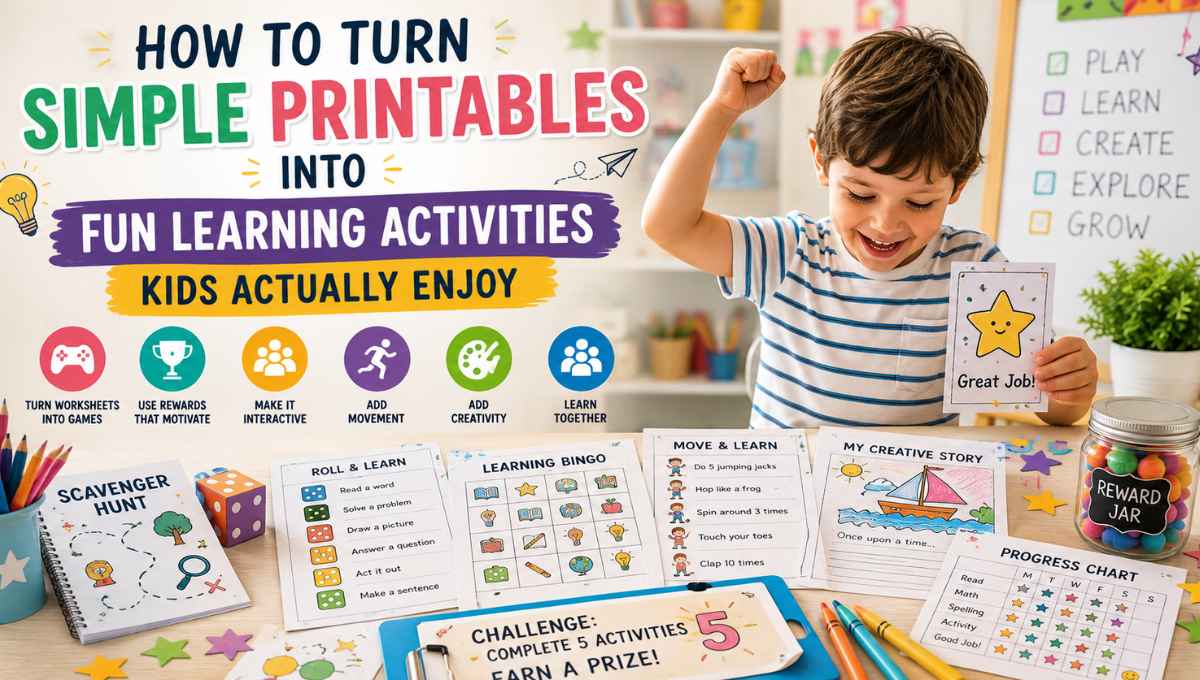
Have you ever printed an educational worksheet only to hear, “Do I have to do this?” You’re not alone. Many parents and teachers download great printable resources, only to discover that children quickly lose interest when learning feels like another chore.
The good news is that the printable isn’t usually the problem—it’s how it’s presented. A simple worksheet can become an exciting challenge, a coloring page can turn into a creative adventure, and a basic matching activity can become a game that children ask to play again.
With just a few small changes, you can transform ordinary printables into engaging learning experiences that encourage curiosity, creativity, and confidence. Better yet, you don’t need expensive supplies or hours of preparation to make it happen.
In this guide, you’ll discover 10 practical strategies that help parents, teachers, and homeschool families turn everyday printables into activities children genuinely enjoy. These simple ideas work with many different types of educational resources, making learning more interactive, memorable, and fun.
Children rarely remember every worksheet they complete—but they often remember the excitement, laughter, and confidence they felt while learning.
Whether you’re working with preschoolers, elementary students, or children learning at home, these creative techniques can help reduce resistance, increase participation, and make learning feel like an adventure instead of another assignment.
Why Some Printables Excite Kids While Others Don’t
Children naturally enjoy exploring, discovering, and solving problems. When a printable feels repetitive or predictable, their interest can fade quickly. But when you introduce a little creativity, movement, storytelling, or friendly competition, that same printable suddenly becomes much more engaging.
<p>The secret isn’t finding more worksheets—it’s finding better ways to use them.</p>
Think of a printable as a starting point rather than the entire activity. A simple alphabet worksheet can become a treasure hunt. A math page can turn into a race against the clock. A coloring sheet can inspire storytelling, role-playing, or creative crafts.
Ready to make printable activities more exciting? Let’s explore ten simple strategies that can transform almost any printable into an experience children will look forward to.
1. Turn Worksheets Into Fun Games
Children love to play. That’s why one of the easiest ways to make printable worksheets more exciting is to turn them into a game instead of another school assignment.
You don’t need expensive educational toys or complicated lesson plans. A little creativity can completely change how children feel about learning.
For example, instead of saying, “Finish this worksheet before dinner,” try saying, “Let’s see if you can solve these five questions before the timer rings!” That small change instantly makes the activity feel like a challenge instead of a chore.
You can also invent simple games using almost any printable resource.
Easy game ideas include:
These ideas work because children naturally enjoy accomplishing small goals. The printable stays the same—but the experience becomes much more enjoyable.
Fun Idea: Let your child become the “teacher” after finishing the worksheet. Ask them to explain the answers back to you. Teaching someone else is one of the best ways to reinforce learning.
2. Use Rewards That Encourage Learning—Not Just Prizes
Rewards can be a wonderful source of motivation, but they don’t have to mean candy, toys, or expensive gifts. In fact, the most meaningful rewards often create lasting memories instead of temporary excitement.
The goal isn’t to convince children to complete worksheets just to earn a prize. Instead, use rewards to celebrate effort, persistence, creativity, and improvement.
When children feel proud of what they’ve accomplished, they’re much more likely to develop confidence and a positive attitude toward learning.
Instead of buying rewards, try offering:
Many children are motivated simply by seeing their progress. Printable reward charts, achievement certificates, and progress trackers help make their success visible while encouraging them to keep learning.
Remember: Praise effort just as much as correct answers. Children who feel encouraged are more willing to try challenging activities in the future.
3. Make Learning Interactive Instead of Passive
One reason children lose interest is that they’re often expected to sit quietly and complete worksheets on their own. While independent work has its place, adding interaction keeps children engaged and makes learning much more memorable.
Instead of treating printables as something children complete alone, turn them into activities you can enjoy together.
Ask questions, encourage conversations, and invite children to explain their thinking. The worksheet becomes the starting point—not the entire lesson.
Simple ways to make printables interactive:
Interactive learning helps children stay focused because they become active participants rather than passive learners. It also strengthens communication, critical thinking, and problem-solving skills.
Most importantly, children begin to associate learning with enjoyable experiences instead of pressure or boredom.
Learning Tip: At the end of every activity, ask one simple question: “What was your favorite part?” Their answer will help you choose activities they’ll be excited to do again.
4. Add Movement to Every Printable Activity
Children aren’t designed to sit still for long periods of time. If a printable activity keeps them in one chair for too long, their attention naturally begins to drift. Fortunately, adding movement is one of the easiest ways to make learning more exciting.
Instead of completing an entire worksheet at the table, encourage children to stand up, walk around, search for answers, or move between different learning stations. Physical movement increases energy, improves focus, and helps many children remember information more effectively.
Even simple changes can make a big difference. A printable worksheet doesn’t have to stay on a desk—it can become part of an active learning adventure.
Easy ways to add movement:
Movement doesn’t distract from learning—it often strengthens it. Children who are actively involved tend to stay engaged longer and enjoy the experience much more.
Activity Tip: After every 10–15 minutes of seated learning, include a two-minute movement break. Stretching, dancing, or walking around the room helps children return with renewed focus.
5. Add Creativity Instead of Looking for Perfect Answers
Many printable activities focus on finding the correct answer—but learning becomes much more enjoyable when children also have opportunities to be creative.
Instead of asking children to complete a worksheet exactly as written, encourage them to personalize it. Let them add drawings, invent stories, color backgrounds, decorate borders, or create their own examples. These small creative choices make the activity feel more personal and memorable.
Creativity also helps children build confidence because there isn’t just one “right” way to express their ideas.
Simple ways to add creativity:
When children are encouraged to add their own ideas, they become active creators rather than passive learners. That sense of ownership often leads to greater enthusiasm and better retention.
Creative Tip: Instead of asking, “Is it finished?” ask, “What could you add to make it even more interesting?” This simple question encourages imagination and critical thinking.
6. Learn Together Instead of Watching From the Sidelines
Children enjoy learning most when they feel supported. One of the easiest ways to increase excitement is to participate alongside them instead of simply supervising.
You don’t need to know every answer or become the teacher. Simply joining the activity shows children that learning is something families can enjoy together.
Ask questions, share ideas, laugh at mistakes, and celebrate discoveries. These moments build stronger relationships while helping children develop confidence and curiosity.
Ways to learn together:
Learning together also gives parents valuable insight into how children think, where they struggle, and what topics interest them the most. Those conversations often become just as valuable as the printable activity itself.
Children don’t always remember every worksheet they complete, but they often remember the time spent learning alongside someone who encouraged them every step of the way.
Family Tip: End each learning session by asking, “What was something new you discovered today?” This simple habit encourages reflection and helps children recognize their own progress.
7. Create Fun Learning Challenges
Children love working toward a goal. Instead of handing them a single worksheet and expecting them to finish it, turn several printable activities into an exciting challenge they can complete over several days or even a full week.
Challenges create anticipation and give children something to look forward to. Every completed activity becomes another step toward reaching a personal goal.
The challenge doesn’t have to be complicated. In fact, simple challenges often work best because children can clearly see their progress.
Fun challenge ideas:
When children finish a challenge, they’re often eager to begin another one. The excitement comes from reaching a goal, not simply completing another worksheet.
Challenge Tip: Give each challenge a fun name like “Super Reader Week”, “Math Explorer Mission”, or “Creative Artist Challenge.” A creative name makes the experience feel like an adventure.
8. Celebrate Progress—Not Perfection
One of the biggest mistakes adults make is waiting until everything is perfect before offering praise. Children benefit much more from having their effort, persistence, and improvement recognized along the way.
Every completed worksheet, every new word learned, and every difficult puzzle solved is a step forward. Celebrating these small victories builds confidence and encourages children to keep trying.
Success doesn’t always mean getting every answer correct. Sometimes success means trying again after making a mistake or finishing an activity that once seemed difficult.
Simple ways to celebrate progress:
When children can see how much they’ve improved, they’re much more likely to stay motivated and continue learning with confidence.
Encouragement Tip: Instead of saying, “You got everything right,” try saying, “I noticed how hard you worked today.” Praising effort helps children develop resilience and a growth mindset.
9. Build Small Learning Habits That Last
Learning doesn’t need to happen for hours every day to make a lasting impact. In fact, short, consistent learning sessions are often more effective than occasional long ones.
Instead of trying to complete dozens of printable activities in one afternoon, focus on building a simple daily habit that children can easily maintain.
Even spending just 15 or 20 minutes each day reading, solving puzzles, practicing math, or completing creative activities can lead to significant progress over time.
Easy daily learning habits:
Consistency is much more valuable than intensity. Children who develop enjoyable daily learning routines often become more confident, independent learners as they grow.
Habit Tip: Connect printable activities to an existing routine. For example, complete one worksheet after breakfast or read together before bedtime. Familiar routines make new habits easier to maintain.
10. Rotate Activities to Keep Learning Fresh
Even the most exciting printable can become repetitive if it’s used the same way every day. One of the easiest ways to maintain enthusiasm is to regularly rotate activities and introduce new learning experiences.
Instead of completing similar worksheets throughout the week, mix different types of printables together. This keeps children curious because they never know exactly what the next activity will be.
Variety also helps children develop a wider range of skills while preventing learning from feeling predictable.
Create a weekly learning mix:
You don’t need to buy new materials every week. Simply using familiar printables in different ways can make them feel fresh and exciting again.
Planning Tip: Keep several printable categories in separate folders. Rotating between reading, math, crafts, puzzles, and creative projects keeps children interested throughout the year.
Learning Is an Experience—Not Just a Worksheet
The most memorable learning moments rarely come from completing a page of questions. They come from solving problems together, celebrating achievements, laughing during games, exploring new ideas, and discovering that learning can actually be fun.
Printable resources are valuable because they provide a starting point, but it’s your creativity, encouragement, and enthusiasm that transform them into meaningful experiences. By creating exciting challenges, celebrating progress, building positive habits, and regularly introducing variety, you help children develop a lifelong love of learning.
The goal isn’t to complete more worksheets. The goal is to create more moments when children smile, stay curious, and discover that learning is something they genuinely enjoy.
Final Thoughts
Making learning enjoyable doesn’t require expensive educational toys, complicated lesson plans, or hours of preparation. Sometimes, the biggest difference comes from changing how you use a simple printable rather than searching for something completely new.
By turning worksheets into games, encouraging creativity, adding movement, celebrating progress, and learning alongside your child, you create experiences that children genuinely look forward to. These small changes can help build confidence, curiosity, and a lifelong love of learning.
Remember, every child learns differently. Some children enjoy solving puzzles, while others prefer storytelling, crafts, or hands-on activities. Don’t be afraid to experiment with different approaches until you discover what motivates your child the most.
The goal isn’t to finish every worksheet as quickly as possible. The goal is to create meaningful moments where children feel excited to learn, ask questions, solve problems, and celebrate their own progress.
The most valuable printable isn’t the one with the most pages—it’s the one that inspires a child to keep learning long after the activity is finished.
With a little creativity and encouragement, even the simplest printable can become the beginning of a memorable learning adventure.
Frequently Asked Questions
How can I make worksheets more exciting for my child?
Instead of presenting worksheets as assignments, turn them into games, scavenger hunts, timed challenges, or creative activities. Adding movement, storytelling, or friendly competition often makes learning much more enjoyable.
What if my child loses interest quickly?
Keep learning sessions short and engaging. Rotate different types of printable activities throughout the week and include regular movement breaks. Variety helps children stay interested and prevents activities from becoming repetitive.
Should I reward my child for completing printable activities?
Positive encouragement is helpful, but rewards don’t have to be expensive. Praise effort, celebrate progress, offer extra story time, or let your child choose the next activity. These experiences often motivate children more than material rewards.
How long should printable learning sessions last?
It depends on the child’s age and attention span. Younger children often benefit from 10 to 20 minutes of focused learning, while older children may enjoy slightly longer sessions. The key is to end while they’re still engaged rather than waiting until they become frustrated.
Can printable activities be used in classrooms as well as at home?
Absolutely. The same strategies work well in classrooms, homeschool settings, tutoring sessions, after-school programs, and family learning time. Teachers can adapt games, challenges, and group activities for larger classes.
How often should I introduce new printable activities?
You don’t need new materials every day. Many printable resources can be reused in different ways. Rotating activities, changing themes, or introducing seasonal topics helps keep learning fresh throughout the year.
Share These Ideas
If these tips helped you make learning more enjoyable, consider sharing this guide with parents, teachers, homeschool families, or friends who are looking for creative ways to use printable resources. A single idea could inspire another family to turn everyday learning into something children truly enjoy.
Latest Articles
Unlock Free Resources
Join the AlaviExpress community and receive free printables, new product alerts, creative inspiration, and exclusive subscriber discounts.